Years Remembered
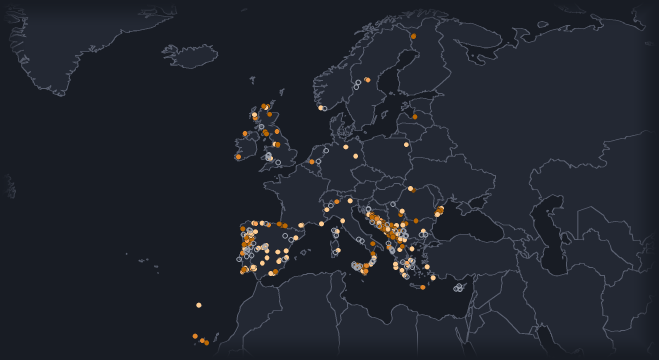
Each patch inside a fire is paired with nearby unburnt ground that looked most like it the year before. The gap is how much more burnt a model scores the patch than its neighbour, a year after the fire and each year after that. A fire's shade counts the years, from the first, in which the gap is more than half its first-year size, with 4 or more as the top shade. A gap that drops below half and comes back is not counted again. Any difference between patch and neighbour that predates the fire is part of the gap.
Of the 320 fires the model trained on, 109 keep more than half their gap after 4 years and 28 show no gap even in the first. The map opens on a German fire from the summer of 2019. Held-out fires are hollow, kept aside to measure the memory below.
How the Memory Fades
On the held-out fires, how well the model tells burnt from unburnt falls a little each year, and remains above a label-free distance between the embeddings before and after the fire, which fades faster. The flat band is the landscape alone, before any fire. By 3 years the model's interval overlaps it, so there part of what it separates may be the landscape itself.
The same embeddings date the fire. A model on the change from the two years before gives the exact EFFIS year for 67.5% of the held-out fires, against 25.9% when the true years are shuffled across them.
Barely Burnt
The fires the model forgets are mostly fires Sentinel-2 barely saw as burnt. Among the 319 training fires, each scored by models that never saw its cluster, 84.1% of those the model is least sure of are barely burnt by Sentinel-2's dNBR one summer on, against 30.8% of those it is surest of. Part of this is mechanical, since Sentinel-2 is among the embedding's inputs, and a low dNBR a year on cannot tell a misdrawn perimeter from fast regrowth.
How this was made
Each fire of at least 500 ha is 3 points at least 250 m inside its EFFIS perimeter, each paired with whichever of 3 unburnt candidates 1 to 3 km away had the closest embedding the year before the fire. A model reads the change in a point's annual AlphaEarth embedding from the two years before the fire to a given number of years after it, and scores burnt against unburnt. Its AUC against EFFIS on the held-out fires is 0.9203, 0.8892, 0.8561 and 0.8217 from 1 to 4 years after the fire (0.7680 to 0.9399 at 3 years). The label-free distance falls from 0.8517 to 0.6733, and at every lag the interval of the model's gain over it is clear of zero.
A fire's gap is the cross-fitted score of its burnt points minus that of their neighbours, one value per year, from a model that never saw the fire's cluster. A fire with no first-year gap counts as none remembered; otherwise the count stops the first year whose gap is below half the first year's.
The split is spatial. Fires within 20 km of each other form a cluster, whole clusters go to training or test, and the nearest held-out point lies 21.3 km from any training point. The 80 held-out fires fall in 53 clusters, and each interval is a bootstrap over them. No Bosnian fire landed in the test set, so the Balkan cluster is not measured out of sample.
Fires in a cluster share years, so the shuffled dating baseline overstates the margin over chance. Among the training fires, with one fire kept per cluster, the exact-year share is 65.8% against 23.8% shuffled, over 116 clusters, and the unburnt neighbours match the EFFIS year at chance (15.0% against 13.6%). A fire below 0.1 dNBR one summer later counts as barely burnt.
This result is exploratory. The method was chosen on the training fires, and 71 of the 80 held-out fires had informed that choice through an earlier random split. The landscape alone, with no fire yet, reaches an AUC against EFFIS of 0.7108 (0.6488 to 0.7784), and the memory curve's interval at 3 years overlaps it. Every skill figure here is measured against EFFIS burnt areas (extract 20260923), a product with its own errors, and a Sentinel-2 scene date is not a fire date.