64 Numbers for Every Place
A satellite sees the same field green in May, bare in October and white in January. AlphaEarth Foundations turns that whole year of views into one list of 64 numbers, the patch's embedding. In practice, places that look and change alike over the year end up with similar lists.
Each list is a vector of length one, so only its direction describes a place. Two places resemble each other when their vectors point the same way, and the angle between the vectors measures how different they are. Every card on this site measures resemblance with that angle.
From 64 Dimensions to Red, Green and Blue
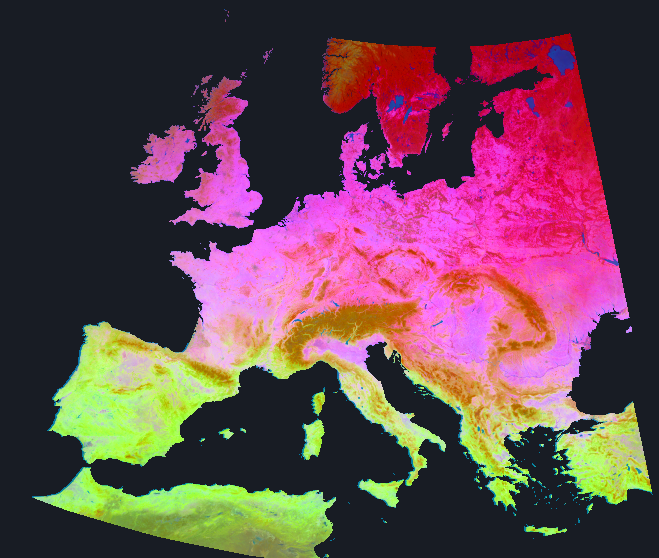
Nobody can draw 64 dimensions, but across Europe most of the variation lies along a few directions. The map averages the embeddings inside each 6 km cell, finds the directions along which Europe varies most, and paints the strongest 3 as red, green and blue. Similar embeddings therefore get similar colours.
Point at any land cell on the map above and it recolours by how closely every other cell resembles it.
How Many Dimensions Europe Uses
Most of the 64 directions add very little. Effectively, Europe's land cells use about 7 of them.
How this was made
The embeddings are AlphaEarth Foundations' annual layer for 2018 at 10 m, read from Source Cooperative (CC-BY). The 10 m vectors inside each cell of the COSMO-REA6 6 km grid are averaged and rescaled to length one. The site compares the embeddings with hand-crafted covariates on this grid.
The colours are the first 3 principal components of the land cells, which together account for 66.6% of the variance, each stretched between its 2nd and 98th percentile. The example places are single cells, and their angles are between the cells' averaged vectors.
The effective dimension is the participation ratio of the covariance spectrum, 7.21. Two nonlinear estimates come out close to it. TwoNN gives 7.31, and the Levina-Bickel estimate over each cell's 20 nearest neighbours has a median of 7.13.
The colouring uses no terrain, temperature or coastline data. ERA5-Land temperature was one of AlphaEarth's own training targets, however, so the embedding is not free of climate. The browser receives the vectors as 8-bit integers, and a cell's 10 nearest neighbours survive that with a mean fidelity of 0.9541.